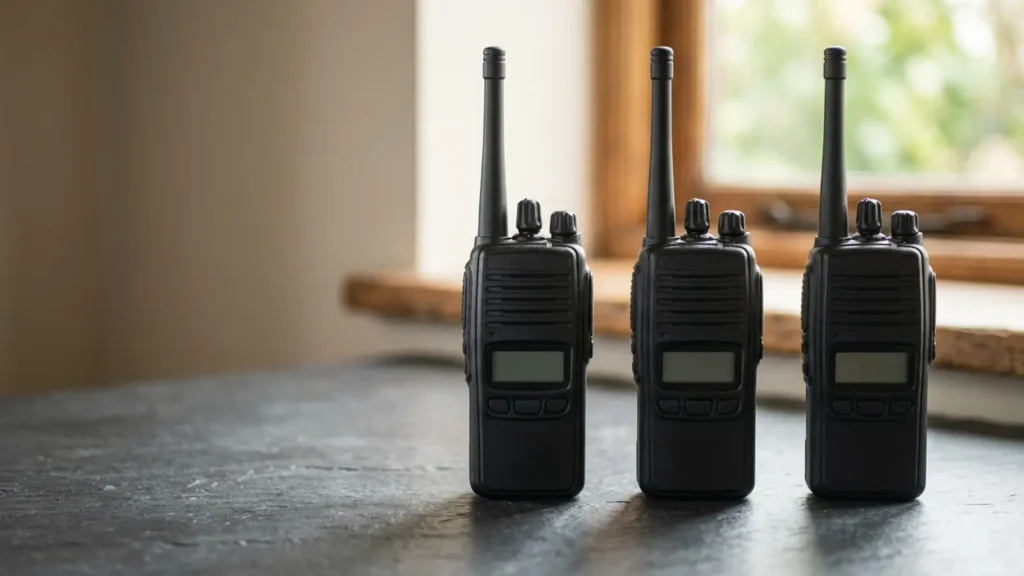
Choosing a GMRS radio is mostly about two things: where the antenna will be, and how much power the rules allow for that station type. This hub compares radio types and specific models, using only manufacturer documents and the FCC rules. We don’t test radios ourselves.
Handheld, mobile or base?
- Handhelds carry their antenna at hand height. They’re the only station type allowed on the 467 MHz interstitial channels (8–14), at 0.5 W ERP (95.1763(d), 95.1767(c)). Many current models are around 5 W, such as Midland’s GXT67 Pro.
- Mobiles mount in a vehicle and use an external antenna. On main channels they may run up to 50 W transmitter output (95.1767(a)).
- Base stations are often mobile radios on a 13.8 V power supply, with an antenna on a mast or roof. The same 50 W main-channel limit applies.
Read the full comparison: GMRS Handheld vs Mobile Radio.
Model comparisons
- Midland MXT275 vs MXT575: 15 W vs 50 W MicroMobile radios, spec by spec.
What to look for on a spec sheet
| Spec | Why it matters |
|---|---|
| GMRS certification and FCC ID | Required for GMRS (95.1761); check the ID in the FCC’s equipment authorization search |
| Rated power | Must suit the channels you’ll use: 50 W only on main channels |
| Repeater channels and split tones | Needed to use most repeaters |
| Antenna connector | Lets you mount an antenna higher (mobiles and bases) |
| Privacy codes (CTCSS/DCS) | Needed for repeater access; they don’t encrypt anything |
| NOAA weather alerts | Useful for rural and emergency use |
| Power source | Vehicle 12 V, a 13.8 V supply, or battery capacity for handhelds |
Power, battery and accessories
Spec sheets differ in how they state battery life, and even one maker can quote different figures on a spec sheet and on a product page. Midland’s GXT67 Pro, for example, lists 16 hours on its spec sheet and “up to 4 days” on its product page. Compare like with like, and read the footnotes. For mobiles, check the supply voltage (13.8 V DC on the MXT575) and the current draw at full power, because a base installation needs a supply that can deliver it. Antenna connectors and cable lengths decide how high you can put the antenna. The MXT275’s magnetic-mount antenna, for instance, comes with a 6 m cable.
Compatibility
Any GMRS or FRS radio on the same frequency, with matching tones, can talk to any other. GMRS rules allow GMRS stations to talk with FRS units (95.1731). FRS radios share channels 1–22 but can’t use repeaters, and they’re capped at 2 W ERP (95.567).
Before you buy
- Decide where the radio will live: pocket, dash or desk.
- Check repeater coverage in your area. If there is some, buy repeater-capable radios.
- Plan the antenna, and check your heights in the range estimator.
- Get your license. See how to get a GMRS license.
Frequently asked
Do more watts mean more miles? Not proportionally. UHF range is limited mainly by antenna height and terrain. See GMRS range explained.
Can I modify a radio to add channels? No. GMRS frequency-determining circuitry and programming controls must be internal and inaccessible from outside the radio (95.1761(c)), and any radio must stay within its certified design.
Are ham radios OK on GMRS? GMRS transmitters can’t be certified if they can also operate in services that don’t require certification, such as amateur radio (95.1761(c)). Use a GMRS-certified radio.
General information, not legal advice. The eCFR text of 47 CFR Part 95 is the authority.
All radios guides
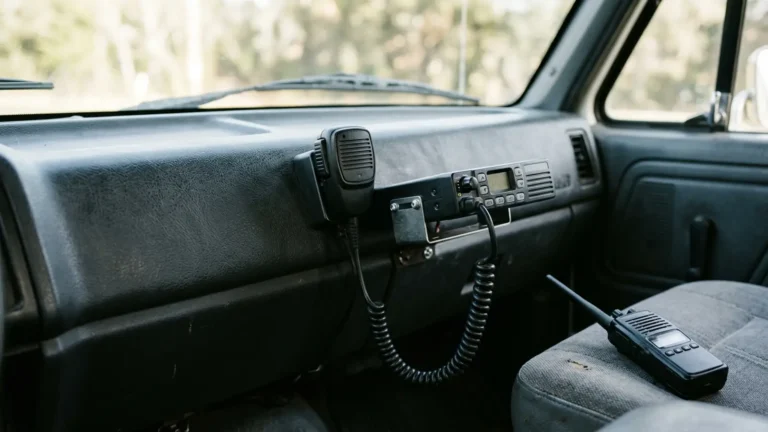 RadiosGMRS Handheld vs Mobile RadioHandheld, mobile and base GMRS radios compared using FCC power limits and Midland spec sheets (GXT67 Pro 5 W, MXT275 15 W,…
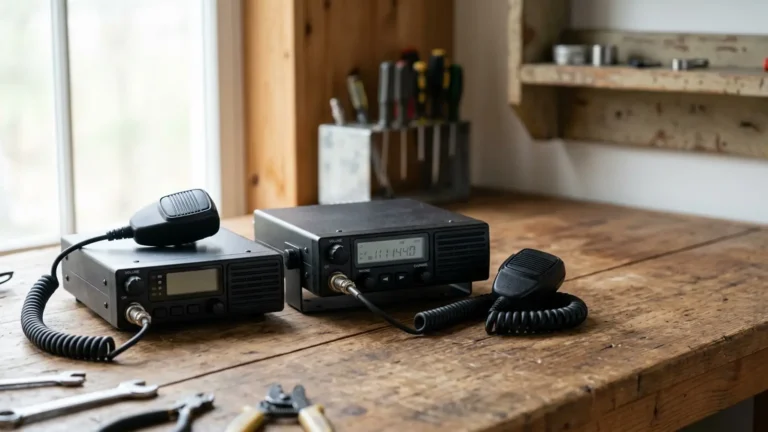 RadiosMidland MXT275 vs MXT575Midland MXT275 vs MXT575 from Midland's spec sheets: 15 W vs 50 W output, channels, repeater support, antennas, power and size, plus…