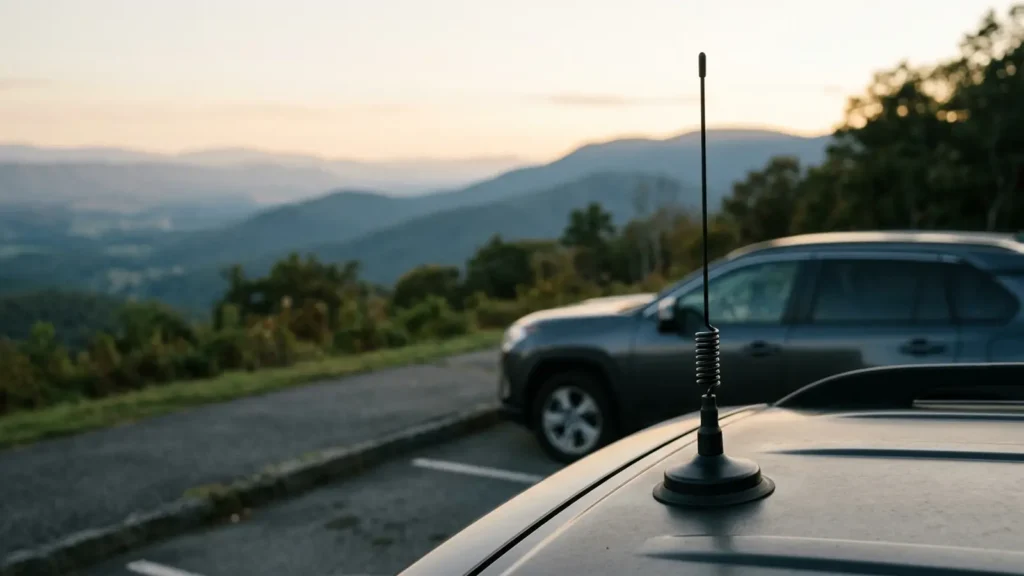
Range is the most-asked GMRS question, and the most over-promised. The FCC’s own figure is “one to twenty-five miles depending on station class, terrain, and repeater use” (FCC). This hub explains the physics and the rules, and gives you a tool to run your own numbers.
Three numbers that matter
- Antenna height above the ground for each station, which sets the radio horizon.
- What’s in the path, such as hills, trees and buildings. It decides whether you get anywhere near the horizon.
- Power and antenna gain, within the rule limits. They decide how much margin a weak path has.
Why height beats watts
GMRS sits around 462–467 MHz (95.1763). Signals at these frequencies travel mostly by line of sight. Over smooth ground, an antenna’s radio horizon is about √(2 × height in feet) miles. Two stations’ horizons add up to the longest clear path between them:
| Antenna heights | Clear-path limit |
|---|---|
| Two handhelds at 6 ft | ≈ 6.9 mi |
| Base at 30 ft + vehicle at 7 ft | ≈ 11.5 mi |
| Repeater at 200 ft + handheld at 6 ft | ≈ 23.5 mi |
Real paths through hills, trees and buildings are shorter. Power within the legal limits helps a weak path get through, but it doesn’t move the horizon.
- GMRS Range Explained: the formula, worked examples and what really limits range.
- GMRS Range & Antenna Height Estimator (tool): enter your heights and print your estimate.
Antennas and the rules
- ERP limits: on channels 1–7, mobile, handheld and base stations are limited to 5 W ERP, and antenna gain counts toward it. Channels 8–14 are 0.5 W ERP, handhelds only (95.1767).
- Main channels: the limit is 50 W transmitter output for mobile, repeater and base stations, regardless of antenna gain.
- Fixed antennas: FRS radios, and GMRS handhelds that send data, must have non-removable antennas (95.587, 95.1787).
- Tall masts: structures over 200 ft, or over 20 ft near airports, may need FAA and FCC review (95.317).
Read the full guide: GMRS Antennas: Height, Gain, ERP and Mast Rules.
Worked example
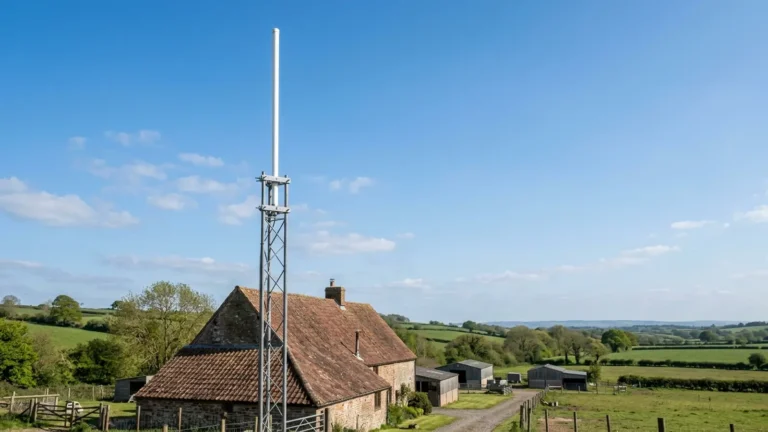
A family base at a farmhouse has a mast antenna at 30 ft and wants to reach a pickup truck with a roof antenna at about 7 ft. Horizons: √60 ≈ 7.7 mi and √14 ≈ 3.7 mi, so the clear-path limit is about 11.5 mi. Dropping the base antenna to 12 ft (√24 ≈ 4.9 mi) cuts the limit to about 8.6 mi, whatever the transmitter power. Raising it to 60 ft (√120 ≈ 11.0 mi) pushes the limit to about 14.7 mi. A ridge between the farmhouse and the truck can block the path at any height, so treat these as upper bounds.
Getting more range legally
- Go higher: a rooftop or mast antenna, or simply a hilltop.
- Go external: a mobile radio with a roof antenna beats a handheld inside a car.
- Cut losses: use short, good-quality coax and sealed connectors.
- Use a repeater, with the owner’s permission. See Repeaters.
- Pick the right channel: use main channels when you need full power.
Frequently asked
Why does the box say 36 miles? It’s a best case. Midland’s own spec sheets say maximum range needs open water or rural areas under optimum conditions.
Is a gain antenna always better? No. Higher gain flattens the pattern, which can weaken coverage close by or below a hilltop. Match it to your terrain.
Does weather affect GMRS range? Normal atmospheric bending is built into the 4/3-Earth horizon formula. Unusual conditions can extend or shorten range, but terrain and height dominate.
General information, not legal advice. The eCFR text of 47 CFR Part 95 is the authority.
All antennas & range guides
 Antennas & RangeGMRS Range ExplainedRealistic GMRS range from the FCC (1 to 25 miles) and the radio-horizon formula: antenna height, terrain, power, repeaters, with worked examples…
 Antennas & RangeGMRS AntennasHow GMRS antennas affect range and legality: height vs gain, dBd vs dBi, ERP limits on interstitial channels, non-removable antenna rules, and…