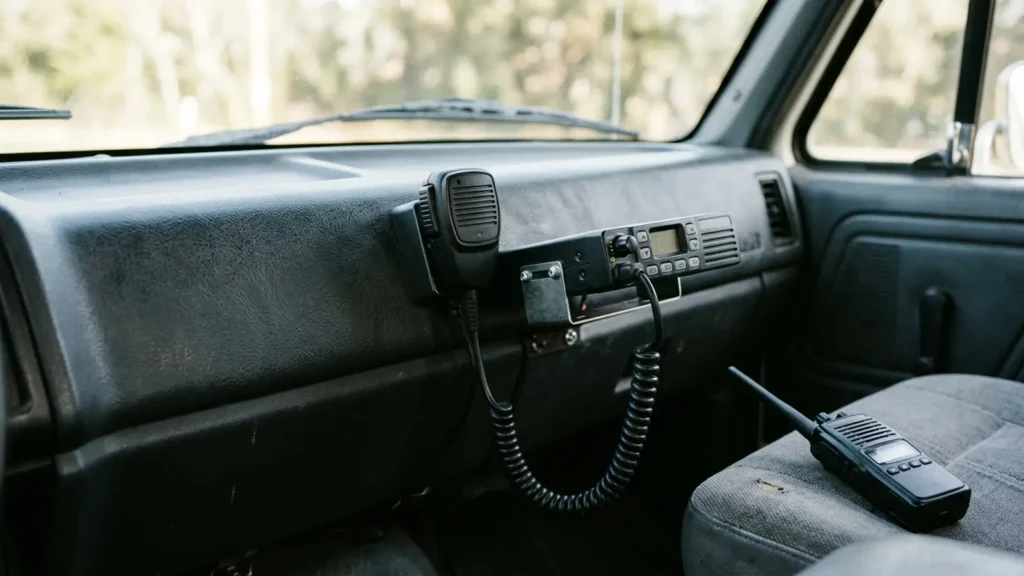
Rules note: You need an FCC license to transmit on GMRS (47 CFR 95.1705). Use only FCC-certified GMRS radios, and stay within the power and channel limits for your station type. This is general information, not legal advice. The eCFR text of Part 95 Subpart E is the authority.
The radio you pick decides your power ceiling and, more importantly, your antenna. This guide compares the three station types allowed under 95.1763 and 95.1767. It uses three current Midland models as examples: the GXT67 Pro handheld and the MXT275 and MXT575 mobiles. We haven’t tested these radios; every figure comes from Midland’s own documents.
On this page
The three station types
| Handheld | Mobile | Base | |
|---|---|---|---|
| Typical power | Up to 5 W (e.g. GXT67 Pro) | 15–50 W (MXT275, MXT575) | Usually a mobile radio on a power supply |
| Main-channel limit | No 50 W allowance listed for handhelds in 95.1767(a) | 50 W output | 50 W output |
| Antenna | Built-in or attached, at hand height | External, on the vehicle roof | External, on a mast or roof |
| 467 MHz interstitials (8–14) | Yes, 0.5 W ERP | No | No |
| Repeater use | Yes, if repeater-capable | Yes | Yes |
Handheld example: Midland GXT67 Pro
Midland lists the GXT67 Pro at 5 W with IP67 dust and water protection. Its channels are 22 standard GMRS/FRS channels, 8 repeater channels with split tones, 28 preset privacy-code channels and up to 49 user-defined channels. It has 142 privacy codes: 38 CTCSS and 104 DCS (Midland product page).
Midland’s own battery-life figures vary: “up to 4 days” on the product page and “16-hour battery life” on the spec sheet and FAQ (spec sheet, FAQ). Midland’s FAQ says that at 5 W the radio “can easily reach up to 5 miles, depending on the terrain.” Midland’s spec sheet adds that “maximum range can only be achieved over water or open rural areas under optimum conditions.”
Mobile example: Midland MXT275 (15 W)
The MXT275 is a 15 W “MicroMobile” with a fully integrated control microphone. It has 15 high-power GMRS channels, 8 repeater channels with split tones, 142 privacy codes and NOAA weather radio. It comes with a magnetic-mount antenna on a 6 m cable (Midland spec sheet).
Mobile example: Midland MXT575 (50 W)
The MXT575 is rated at 50 W, the maximum transmitter output allowed for mobile stations on the main channels (95.1767(a)). It has 15 high-power GMRS channels and 8 split-tone repeater channels, plus wide/narrow band and high/low power settings. It takes 13.8 V DC nominal power and ships with a magnetic-mount antenna (spec sheet, user guide).
Midland’s FAQ notes that GMRS frequencies “primarily depend on line of sight for optimal range” (Midland).
Why the antenna matters more than the watts
UHF signals travel roughly in straight lines. Raising the antenna pushes back the radio horizon, while extra power mainly helps a marginal signal get through. A mobile radio’s biggest advantage is an antenna outside the vehicle’s metal body, above the roof. See antenna height and gain and try heights in the range estimator.
Which to buy
- Hiking, kids, around the house: handhelds. Pick repeater-capable models if a repeater covers your area.
- Vehicles, ranch trucks, convoys: a mobile with a roof antenna.
- A home base: a mobile radio on a 13.8 V supply with an antenna on a mast. Check the airport and tall-structure rules (95.317).
- Mixed family: one licensed GMRS mobile plus handhelds. All can share channels 15–22.
Compatibility
Midland says the MXT575 is compatible with all Midland FRS and GMRS radios (user guide). Any certified GMRS or FRS radio on the same frequency, with matching privacy codes, can talk to any other. Privacy codes (CTCSS/DCS) don’t make a conversation private; they only filter what your radio plays.
Buying checklist
- Certified for GMRS? Each GMRS transmitter must be certified (95.1761). Look for the FCC ID on the radio or in the manual, and check it in the FCC’s equipment authorization search.
- Not a GMRS/FRS combination radio. New combination radios can’t be sold since September 30, 2019 (95.1791).
- Repeater capable, with split tones, if you’ll use repeaters.
- Antenna connector on mobiles and bases, so you can mount the antenna high.
- Power options that suit your vehicle or base supply.
- NOAA weather alerts, if you want them. Many Midland models list them.
FAQ
Do mobile radios need a license?
Yes. All GMRS stations do (95.1705).
Can I use a mobile radio as a base?
Yes, with a suitable power supply and antenna. A base station has the same 50 W main-channel limit.
Is 50 W always better than 15 W?
Not necessarily. Antenna height and placement usually matter more, and higher power drains a vehicle battery faster.