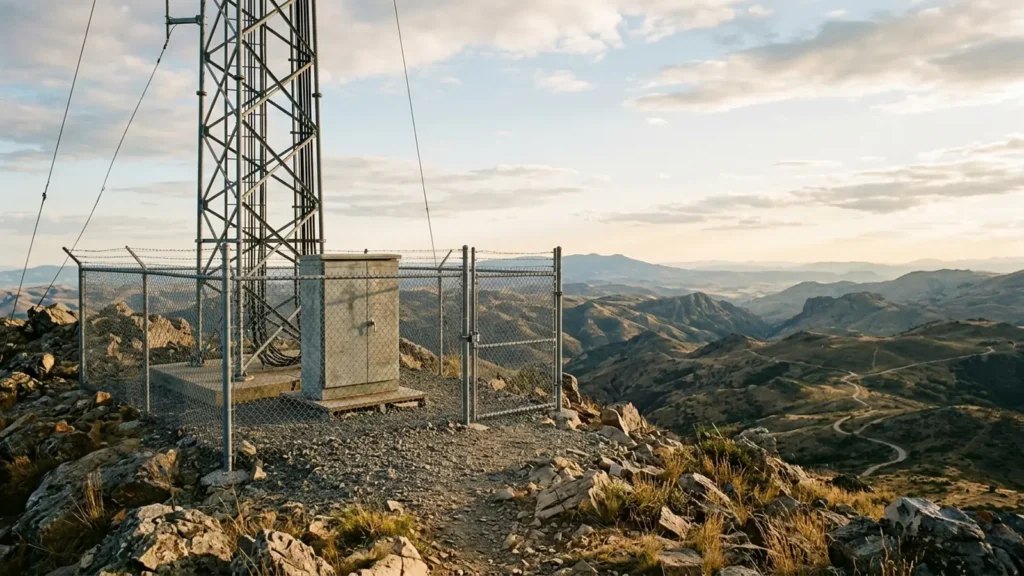
Repeaters are how GMRS users reach well beyond the horizon. A repeater on a hill or tower listens on a 467 MHz input and retransmits on the paired 462 MHz output, at up to 50 W (95.1763, 95.1767). This hub explains how they work, how to get on one, and the rules for owners and users.
The basics
- Pairs: every 462 MHz main channel pairs with the 467 MHz main channel 5 MHz above it, e.g. 462.5500 ↔ 467.5500.
- Who transmits where: repeaters transmit only on the 462 MHz main channels. Mobiles and handhelds transmit on the 467 MHz main channels only through a repeater or for brief tests (95.1763(a), (c)).
- Tones: most repeaters require a CTCSS or DCS access tone. Subaudible tones may be sent continuously; audible tones are limited to 15 seconds (95.377).
- Permission: the owner decides who may use the repeater (95.1705(d)).
Read more:
- GMRS Repeaters Explained: inputs, outputs, tones, identification, sharing and running your own.
- How to Use a GMRS Repeater: permission, programming, testing and etiquette.
- GMRS Repeater Offset & Tone Planner (tool): pick the output, set tones and print your settings.
- GMRS for Emergencies: emergency priority, who may transmit, and a family plan.
What the FCC says about linking
The FCC GMRS page states that repeaters “may not be linked via the internet” to extend communications across a large area. Linking repeaters so a distant repeater retransmits your signal violates 95.1733(a)(8) and 95.1749 (FCC). Networks may be used only to remote-control a repeater (95.1745, 95.1749).
Why repeaters reach so far
The range advantage comes almost entirely from height. A handheld at 6 ft has a radio horizon of about 3.5 mi. A repeater antenna at 200 ft has about 20 mi. Together, that’s a clear-path limit near 23.5 mi between a handheld and the repeater, and two handhelds on opposite sides of the repeater can be farther apart still. Repeater power is capped at 50 W like a base station, so the gain comes from the site, not the transmitter.
For repeater owners
- Operate under your individual license, within 50 W, with a certified GMRS transmitter (95.1761).
- Automatic and remote control are allowed (95.1745, 95.1747).
- Identify unless the repeater only serves stations under your own license (95.1751(c)).
- Shared arrangements must be free, non-profit cost-sharing or reciprocal, under a written agreement kept with your station records (95.1705(f), 95.1723).
- Check the antenna structure and airport rules for your site (95.317).
Planning a repeater trip
Before you travel, look up repeaters along your route, and contact the owners for permission and tone settings. Program each one into its own memory with the output frequency, the +5 MHz input and the access tone. Label the memories clearly, because many radios show only a channel number. Test from a known location before you rely on a repeater, and keep a simplex channel agreed with your group for when you’re out of repeater range. The repeater planner prints a one-page card with each pair and tone.
Etiquette in one list
Listen first. Keep transmissions short. Leave gaps between exchanges. Identify. Give way to emergency traffic, which has priority on every channel (95.1731(a)).
Frequently asked
Can FRS radios use repeaters? No. They can’t transmit on the 467 MHz main channels.
Do privacy codes make repeater talk private? No. Anyone on the output hears the conversation. Codes only control access and squelch.
Do I need a special license to own a repeater? No separate license type is listed. Repeaters operate under your GMRS individual license.
General information, not legal advice. The eCFR text of 47 CFR Part 95 is the authority.
All repeaters guides
 RepeatersGMRS Repeaters ExplainedHow GMRS repeaters work under 47 CFR 95.1763 and 95.1767: 467 MHz input, 462 MHz output, +5 MHz pairs, 50 W, CTCSS/DCS…
 RepeatersHow to Use a GMRS RepeaterA step-by-step guide to using a GMRS repeater: getting permission, programming the 467 MHz input and 462 MHz output, CTCSS/DCS tones, testing,…
 RepeatersGMRS for EmergenciesUsing GMRS in emergencies under 47 CFR 95.1731 and 95.1705: priority for emergency traffic, anyone may send an emergency message, the Mayday…