Rules note: You need an FCC license to transmit on GMRS (47 CFR 95.1705). Use only FCC-certified GMRS radios, and stay within the power and channel limits for your station type. This is general information, not legal advice. The eCFR text of Part 95 Subpart E is the authority.
If you can change one thing about a GMRS setup, change the antenna. Height sets your radio horizon, and gain shapes where the energy goes. The rules also care about antennas: ERP limits apply on some channels, some radios must keep their factory antenna, and tall masts can trigger FAA and FCC rules.
On this page
Height first
Radio horizon grows with the square root of antenna height: horizon (miles) ≈ √(2 × height in feet). See GMRS range explained for where this comes from. Moving an antenna from 6 ft to 24 ft doubles its horizon (3.5 → 6.9 miles). Going from 25 ft to 100 ft doubles it again (7.1 → 14.1 miles). Try your own heights in the range estimator.
Gain, explained
Antenna gain compares how strongly an antenna radiates in its best direction against a reference antenna:
- dBd: gain over a half-wave dipole.
- dBi: gain over a theoretical isotropic radiator. dBi = dBd + 2.15.
A vertical “gain” antenna squeezes energy toward the horizon, which helps over flat ground. It can leave weaker coverage close in, or below you if you’re on a hill. Higher gain isn’t automatically better; match the antenna to your terrain.
ERP: where gain meets the rules
Effective radiated power (ERP) is transmitter power, minus cable loss, multiplied by antenna gain relative to a dipole. Three rules depend on it (95.1767):
- 462 MHz interstitials (channels 1–7): 5 W ERP maximum for mobile, handheld and base stations.
- 467 MHz interstitials (channels 8–14): 0.5 W ERP maximum, handhelds only. Radios must be designed so ERP can’t exceed this.
- Main channels: the limit is transmitter output (50 W for mobile, repeater and base; 15 W fixed), not ERP.
A worked example for channels 1–7: a 5 W radio into an antenna with 3 dBd net gain (×2 after cable loss) gives roughly 10 W ERP, over the 5 W limit. Lower the power or use a main channel. The conversion is 10^(dB/10): 3 dB ≈ 2×, 6 dB ≈ 4×.
Antennas you can’t change
- FRS radios: the antenna must be non-removable, with gain no greater than a half-wave dipole (95.587).
- GMRS handhelds that send digital data: “The antenna must be a non-removable integral part of the GMRS unit” (95.1787(a)(4)).
Don’t modify a radio’s antenna or circuitry beyond what its certification allows. Only the certification grantee may modify a certified design (95.335(c)).
Masts, towers and airports
Part 95 points to the FCC’s antenna structure rules (95.317):
- An antenna structure more than 200 ft (60.96 m) above ground may require FAA notification and FCC registration (Part 17).
- Near a military or public-use airport, antenna structures more than 20 ft high may face extra limits. The rule of thumb in 95.317(b): the top of the antenna must not exceed one meter above airport elevation for every hundred meters from the nearest runway. The FCC’s TOWAIR tool helps you check.
Local zoning, HOA rules and building codes may also apply to masts. Check before you build.
Practical setups
| Use | Antenna approach |
|---|---|
| Vehicle | Roof-center magnetic or permanent mount. Midland’s MXT275 and MXT575 ship with magnetic mounts (MXT275, MXT575) |
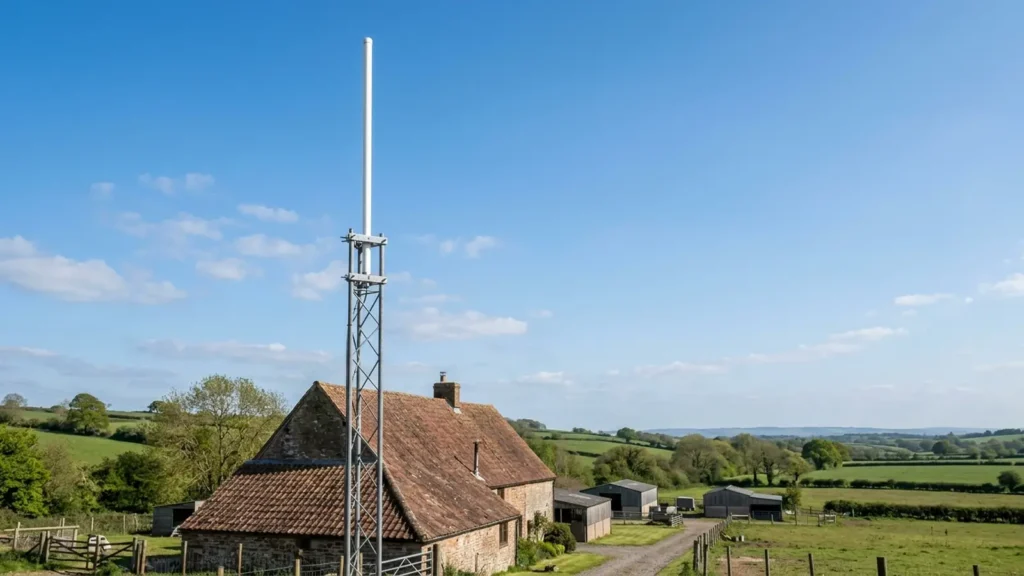
| Home base | Vertical on a roof or mast. Keep the coax as short as practical |
| Hilltop property | Moderate gain, since high-gain patterns can send energy over the valley you want to cover |
| Handheld | Factory antenna; get higher, like stepping onto a rise |
Mounting checklist
- Mount the antenna clear of metal roofs, gutters and other antennas where possible.
- Keep well away from power lines when raising masts.
- Ground and weatherproof outdoor installations following the antenna maker’s instructions and your local electrical code.
- On vehicles, center the antenna on the roof for the most even pattern.
- Recheck the 5 W ERP limit if you transmit on channels 1–7 with a gain antenna (95.1767(b)).
Coax
Every foot of cable loses some signal, and loss rises with frequency. At 462–467 MHz, long runs of thin cable can waste a large share of your power. Use the cable your antenna or radio maker recommends, keep connectors weather-sealed, and avoid unnecessary adapters.
FAQ
Is a taller antenna legal?
Generally yes, within Part 17, airport and local rules. Part 95 has no separate GMRS height limit for individual licensees, beyond the conditions on grandfathered pre-1987 licenses (95.1705(g)).
Can I put a gain antenna on channels 1–7?
Yes, but keep ERP at or below 5 W.