Rules note: You need an FCC license to transmit on GMRS (47 CFR 95.1705). Use only FCC-certified GMRS radios, and stay within the power and channel limits for your station type. This is general information, not legal advice. The eCFR text of Part 95 Subpart E is the authority.
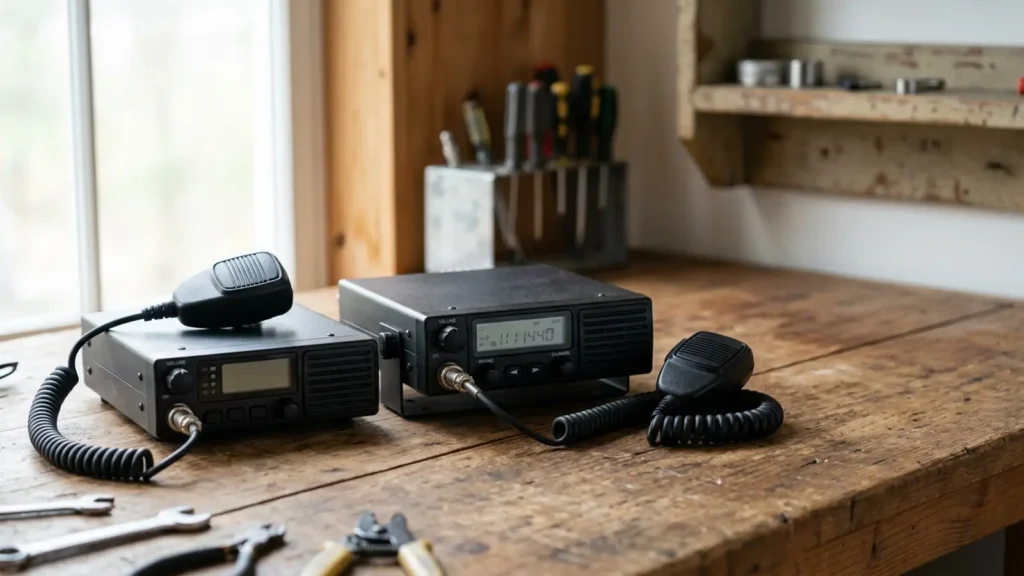
Midland’s MXT275 and MXT575 are two of the best-known GMRS mobile radios. Both are “MicroMobile” designs, with the controls in the microphone and a small radio body you can hide away. The headline difference is power: 15 W vs 50 W. This comparison uses only Midland’s published documents; we haven’t tested either radio.
On this page
Spec comparison
| Spec | MXT275 | MXT575 |
|---|---|---|
| Rated power | 15 W (“Full 15 Watt Radio”) | 50 W (“Full 50 Watt Radio”) |
| GMRS channels | 15 high-power channels + 8 repeater channels | 15 high-power channels + 8 repeater channels |
| Repeater tones | Split-tone capable | Split-tone capable |
| Privacy codes | 142 | 142 (38 CTCSS / 104 DCS) |
| Bandwidth | Not listed on spec sheet | Narrow and wide band |
| Power settings | High/low channels (spec sheet) | High/low settings |
| Weather | NOAA weather radio | NOAA weather scan + alert |
| Antenna | Magnetic-mount antenna, 6 m cable | Magnetic-mount antenna |
| Charging port | USB-C (fast charging) | USB-C (QC 3.0/2.0 36 W max; PD 12 V @ 3 A) |
| Size (H × W × D) | 1.4 × 5 × 4.2 in (earlier spec sheet) | 5.5 × 1.5 × 7.3 in |
| Weight | 1.3 lb | 3 lb |
| Power source | 12 V power cord with car adapter | 13.8 V DC nominal |
Sources: MXT275 spec sheet (USB-C); MXT575 spec sheet, MXT575 product page and user guide, checked Oct 12, 2026. Midland notes that specifications are subject to change.
What the 50 W means legally
50 W is the most transmitter output the rules allow for mobile, repeater and base stations, and only on the main channels (95.1767(a)). On channels 1–7 (462 MHz interstitials), the limit is 5 W ERP for mobile stations (95.1767(b)). Midland describes both radios as having 15 “high power” channels: GMRS channels 1–7 and 15–22, per the MXT275 sheet. Check the manual for how power is set on the interstitial channels.
Does 50 W give 3× the range of 15 W?
No. Range on UHF is limited mainly by line of sight: antenna heights, terrain and obstructions. Midland’s own FAQ says GMRS “primarily depend[s] on line of sight for optimal range” (Midland). Its spec sheets add that maximum range needs open water or rural areas under optimum conditions (MXT275 sheet).
Raising power helps a weak but present path get through. It won’t push a signal over a hill. Model your path with the range estimator.
Which to choose
- MXT275: smaller and lighter, enough for convoys, trail runs and farm trucks over shorter distances, or when you mainly use repeaters.
- MXT575: maximum legal power for large properties, long simplex paths and fringe repeater coverage. It draws more current, so plan your wiring.
Both work with Midland FRS and GMRS handhelds on shared channels (MXT575 guide). Both need a GMRS license (95.1705).
Installation notes
- Antenna placement: a roof-centered magnetic mount gives the clearest pattern. Route the coax without kinks.
- Power: follow the manual’s wiring instructions and fuse rating for your radio.
- Repeater setup: use the 8 repeater channels with the repeater’s tones. See how to use a GMRS repeater.
Using them with handhelds
Both radios have 8 repeater channels and split-tone support. A family can put handhelds and a mobile on the same repeater pair, using the same tones. Off-repeater, use a main channel (15–22) so the mobile can run full power (95.1767(a)). Handhelds will hear the mobile from farther away than the mobile hears them, because the mobile has more power and a better antenna. Plan meeting points within handheld range, or use a repeater.
What neither spec sheet tells you
Neither sheet lists receiver sensitivity or current draw on transmit. For wiring, rely on the owner’s manual and the fuse supplied with the power cord. For real-world coverage, antenna height and terrain decide more than the spec table does. See the range estimator.
FAQ
Can I run the MXT575 as a base station?
Yes, with a suitable 13.8 V supply and antenna. Base stations have the same 50 W main-channel limit.
Do they talk to FRS radios?
Yes, on the shared channels. FRS radios can’t use repeaters.
Is the magnetic antenna the best option?
It’s convenient. A permanently mounted, well-placed antenna may perform better. See antenna height and gain.