Rules note: You need an FCC license to transmit on GMRS (47 CFR 95.1705). Use only FCC-certified GMRS radios, and stay within the power and channel limits for your station type. This is general information, not legal advice. The eCFR text of Part 95 Subpart E is the authority.
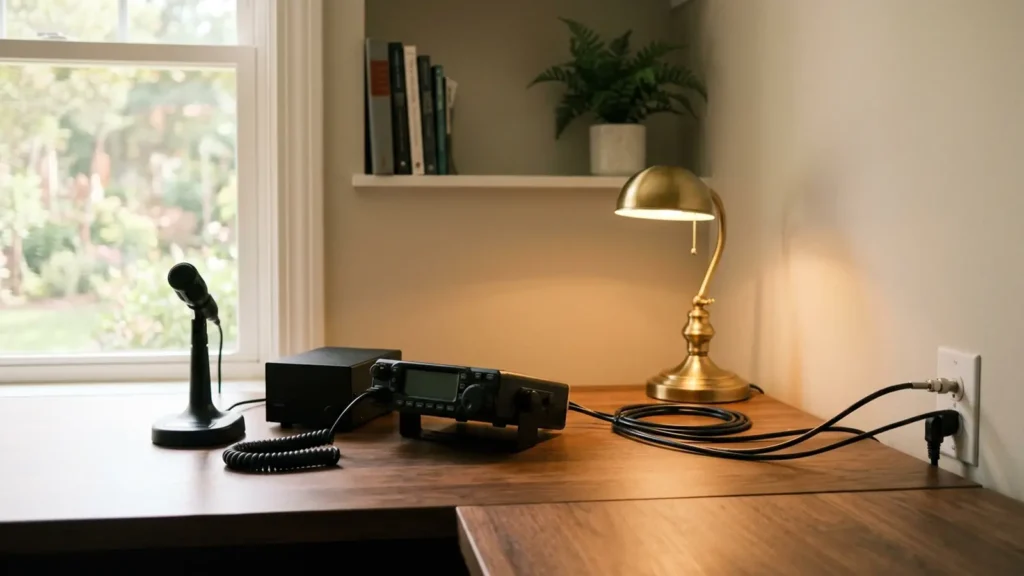
A base station is the GMRS radio at your house. It’s usually a mobile radio on a desk power supply, connected by coax to an antenna on the roof or a mast. It can be a major range upgrade, because antenna height matters a lot at UHF. See GMRS range explained.
On this page
Base or control station? It depends on the channel
Part 95 defines station types by what they do (95.303):
- Base station: “at a fixed location that communicates directly with mobile stations and other base stations.”
- Control station: at a fixed location, communicating “with mobile stations and other control stations through repeater stations.”
- Fixed station: at a fixed location that talks only to other fixed stations.
The same home radio can act as either a base or a control station. Talking simplex on 462 MHz channels, it’s a base station. Talking through a repeater on a 467 MHz input, it’s a control station. Base stations may not transmit on the 467 MHz main channels, but control stations may when communicating through a repeater (95.1763(c)).
Power limits for a home station
| Channels | Base station limit |
|---|---|
| 462 MHz main (15-22) | 50 W transmitter output (95.1767(a)(1)) |
| 462 MHz interstitial (1-7) | 5 W ERP (95.1767(b)) |
| 467 MHz interstitial (8-14) | Handhelds only; a base can’t transmit here (95.1763(d)) |
| 467 MHz main (repeater inputs) | As a control station through a repeater, or brief tests per 95.319(c) (95.1763(c)) |
On 1-7 the limit is ERP, so a gain antenna counts against it. On 15-22 the limit is transmitter output. In every case use “the minimum amount of transmitting power necessary” (95.367). ERP and gain are explained in antenna height and gain.
The parts list
- A GMRS-certified mobile or base radio. Check its FCC ID (95.1761); see how to check.
- A 13.8 V DC power supply sized for the radio’s transmit current from its manual. Compare: Shop 13.8v power supply on Amazon →.
- A UHF base antenna tuned for 462-467 MHz. Compare: Shop gmrs base antenna on Amazon →.
- Low-loss coax as short as practical. At UHF, long thin coax eats much of the gain you paid for.
- Mast, mounts, lightning protection and grounding per the antenna maker’s instructions and local code.
Prices change often; check current prices before you buy.
Antenna height and airports
Part 95 doesn’t set a flat GMRS antenna height cap, but two rules apply (95.317):
- Over 200 ft above ground: antenna structures may need FAA notice and FCC registration under Part 17.
- Near airports: stations on or near a military or public-use airport with an antenna structure over 20 ft “may have to obey additional restrictions.” The highest point must not exceed 1 m above airport elevation per 100 m from the nearest runway.
HOA rules, building codes and permits are separate from the FCC rules. Check them before putting up a mast.
Remote control
Base, repeater and fixed stations may be operated by remote control (95.1745). They may connect to the phone network or the internet “for the sole purpose of operation by remote control” (95.1749). Carrying GMRS conversations over the internet isn’t allowed. The FCC’s GMRS page spells this out for linked repeaters (FCC).
RF exposure
A roof antenna at legal power is normally well away from people, but placement still matters. See GMRS RF exposure safety.
FAQ
Can my kids use the base station? Yes, as immediate family under your license (95.1705(c)(2)). The licensee, not the minor, is responsible for a base station operated by someone under 18 (95.1743).
Do I need a separate license for a base? No. One individual license covers your stations (95.1705).
Is a 50 W base better than 15 W? Higher power helps a little at the edge of coverage. Antenna height usually helps far more. See MXT275 vs MXT575 for the 15 W vs 50 W comparison.
Sources: 47 CFR 95.303, 95.317, 95.367, 95.1705, 95.1743, 95.1745, 95.1749, 95.1761, 95.1763, 95.1767; FCC GMRS page. Checked October 13, 2026.