Rules note: You need an FCC license to transmit on GMRS (47 CFR 95.1705). Use only FCC-certified GMRS radios, and stay within the power and channel limits for your station type. This is general information, not legal advice. The eCFR text of Part 95 Subpart E is the authority.
GMRS radios transmit radio-frequency (RF) energy, and the FCC sets exposure limits for it. This page explains which limits apply to GMRS equipment, what the radio’s certification already covers, and what’s left to you when you install antennas.
On this page
The FCC’s framework
The FCC adopted limits for field strength and power density for transmitters from 300 kHz to 100 GHz, and specific absorption rate (SAR) limits for devices used close to the body. Its requirements are in 47 CFR 1.1307(b), 1.1310, 2.1091 and 2.1093 (FCC RF Safety). Personal Radio Services devices are subject to 1.1307(b), 2.1091 and 2.1093 (95.385(a)).
Handhelds: SAR, covered by certification
- Portable devices are evaluated for SAR under 47 CFR 2.1093, which applies to Personal Radio Services devices (95.385(a)).
- For the general public, the SAR limit is 1.6 W/kg averaged over any 1 gram of tissue, and 4 W/kg over 10 grams for hands, wrists, feet, ankles and ears (1.1310(c)).
The grant for your radio, found through its FCC ID, shows the RF exposure basis for certification. The FCC’s RF page explains how to read SAR information from a grant (FCC). See how to check a GMRS radio’s FCC ID.
Mobiles and base antennas: MPE limits
For antennas away from the body, the FCC uses Maximum Permissible Exposure (MPE) limits. For the general population from 300 to 1,500 MHz, the power density limit is f/1500 mW/cm², with f in MHz, averaged over 30 minutes (1.1310(e)(1), Table 1).
| Frequency | General-population MPE (f/1500) |
|---|---|
| 462.55 MHz | about 0.31 mW/cm² |
| 467.725 MHz | about 0.31 mW/cm² |
That’s the limit, not a measurement. Actual exposure depends on power, antenna gain, duty cycle and distance. The FCC’s OET Bulletin 65 describes accepted methods for evaluating compliance (FCC).
Practical placement
- Follow the radio and antenna manuals. Many mobile and base radio manuals give a minimum separation distance between the antenna and people. That figure comes from the maker’s RF exposure evaluation.
- Mount vehicle antennas per the radio and antenna manuals. The FCC’s RF page links a consumer guide on vehicle-mounted antennas (FCC).
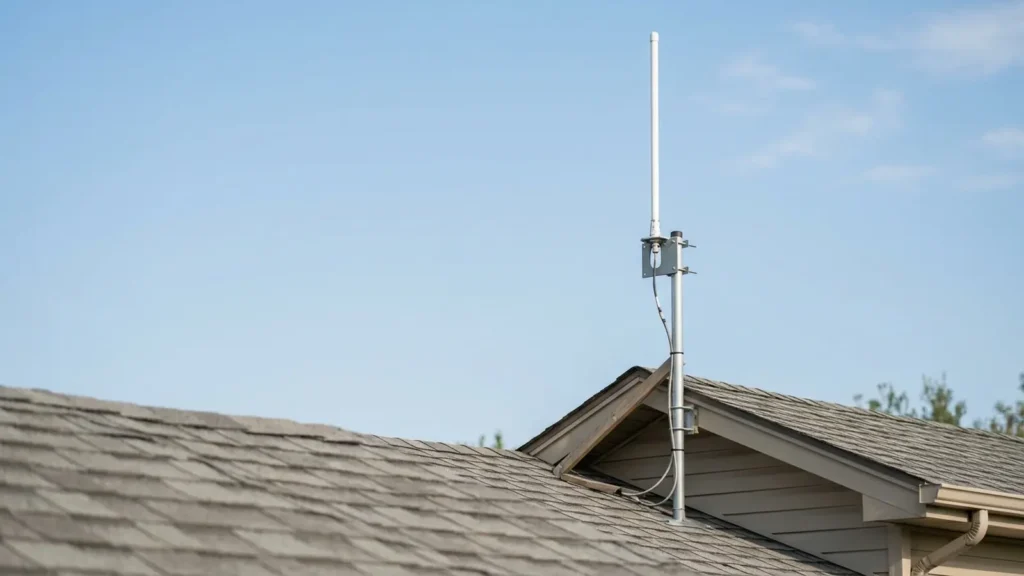
- Keep base antennas up and away. A roof or mast antenna puts distance between the radiating element and living spaces. That also helps range; see base station setup.
- Use the minimum power that works. It’s already required (95.367), and it reduces exposure.
- Don’t transmit while someone is next to a mobile antenna. Ask passengers and helpers to stand clear when testing.
- Talk in short transmissions. Exposure limits are averaged over time; GMRS voice use is typically intermittent.
FAQ
Is a 5 W handheld held to my head safe? Portable devices are evaluated against the SAR limits under 2.1093 (95.385(a)). Follow the manual’s body-worn and face-held instructions.
Does a gain antenna increase exposure? It concentrates energy toward the horizon. In the main beam that raises the power density at a given distance. Height and distance are the main controls.
Who checks a home base station? The FCC’s exposure rules apply to the station. Use the manufacturer’s separation guidance and the OET Bulletin 65 methods if you need to evaluate it (FCC).
Sources: FCC Radio Frequency Safety; 47 CFR 1.1310, 95.367, 95.385. Checked October 13, 2026.